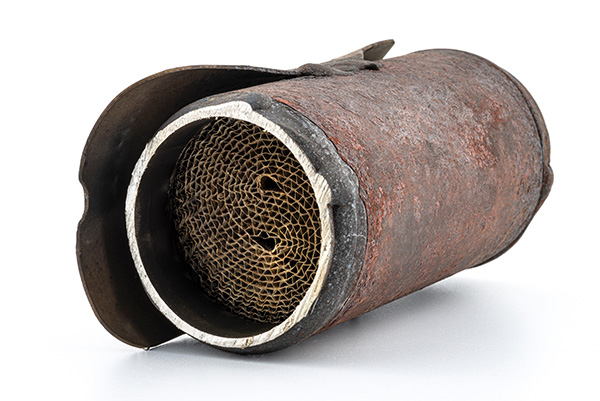
A clogged catalytic converter can sneak up on you. At first, the car might just feel a little sluggish or “heavier” than normal. Over time, it may struggle on hills, hesitate when you accelerate, or even stall. By the time most drivers suspect the converter, it has usually been restricted for a while, and the engine has been working much harder than it should.
Why the Catalytic Converter Matters
The catalytic converter sits in the exhaust system and cleans up harmful gases before they leave the tailpipe. Inside, there is a honeycomb structure coated with precious metals that help turn unburned fuel and pollutants into less harmful emissions. For that to work, exhaust has to flow through it freely.
When the converter is healthy, gases pass through with minimal restriction, and the engine can breathe. If that honeycomb melts, breaks apart, or gets coated with deposits, it becomes a bottleneck. The engine has to push exhaust out against a plugged passage, which is where the trouble starts.
Early Symptoms of a Clogged Catalytic Converter
A restriction usually starts with mild, easy-to-miss signs. You might notice the car feels weak when merging onto the highway or going up a long grade, even though it still idles fairly smoothly. It can feel like someone is gently pressing the brake pedal as you try to accelerate.
Fuel economy may drop because the engine has to work harder for the same speed. Some drivers report a faint rotten egg smell from the exhaust when the converter is stressed. If the blockage grows, you can see more serious symptoms like stalling after a hard run, or an engine that starts fine cold but loses power as everything heats up.
How a Clogged Converter Affects Performance and Engine Heat
Exhaust needs to move out of the cylinders quickly so fresh air and fuel can come in. A clogged converter traps exhaust in the system, which raises backpressure. That makes it hard for the engine to clear each cylinder, so you lose power and response. It can feel like you are driving with a trailer attached, even when the car is empty.
All that trapped heat and pressure tend to build upstream. Exhaust manifolds, O2 sensors, and nearby wiring can see higher temperatures than they were meant to handle. On some vehicles, the converter itself can glow red-hot under severe restriction. That is one reason we take suspected converter issues seriously and do not recommend pushing a car hard when it is already struggling.
Warning Signs You Should Not Ignore
As the blockage gets worse, the symptoms become harder to ignore. Common red flags include:
- Severe lack of power, especially under load
- Engine stalling or shutting off after driving at higher speeds
- A rattling noise from under the car if the internal substrate has broken up
- Check engine light with codes related to efficiency or O2 sensors
- Excessive heat or a strong sulfur smell from the exhaust area
If you are pressing the gas and the engine revs slowly, or the car can barely climb a hill that it handled fine last year, it is time to have the exhaust system checked instead of forcing it along.
Common Causes of Catalytic Converter Damage
Converters rarely clog for no reason. Most of the time, something upstream has been bothering it for a while. Misfires, rich fuel mixtures, and burning oil can all push unburned fuel and contaminants into the converter. That extra load overheats and coats the honeycomb inside until it either melts or plugs up.
Long-term neglect of engine problems is a big factor. Driving for weeks with a flashing check engine light, ignoring rough running, or letting an oil-burning engine go unchecked can all shorten converter life. We see many failed converters that are really the final symptom of a fuel or ignition issue that was never addressed.
How Technicians Diagnose a Clogged Converter
When we suspect a converter problem, we do more than just look at it from the outside. A technician may start by checking for exhaust flow at the tailpipe and scanning for engine codes. From there, we can compare readings from upstream and downstream oxygen sensors to see how the converter is behaving.
Backpressure tests and temperature readings across the converter help confirm whether it is restricted. In some cases, we inspect the substrate with a borescope. The goal is to verify that the converter is truly the problem and not just reacting to another issue, so any repair actually fixes your drivability complaints instead of masking them.
Get Catalytic Converter Repair in Garland, TX with North Dallas Imports
If your car feels gutless on hills, stalls after a hard drive, or you suspect the catalytic converter might be clogged, this is the moment to get ahead of it. We can test exhaust flow, check sensor data, and find out whether the converter itself is restricted or if something else is causing the trouble.
Schedule catalytic converter repair in Garland, TX with North Dallas Imports, and we will help restore your engine’s power while protecting your emissions system for the long haul.